
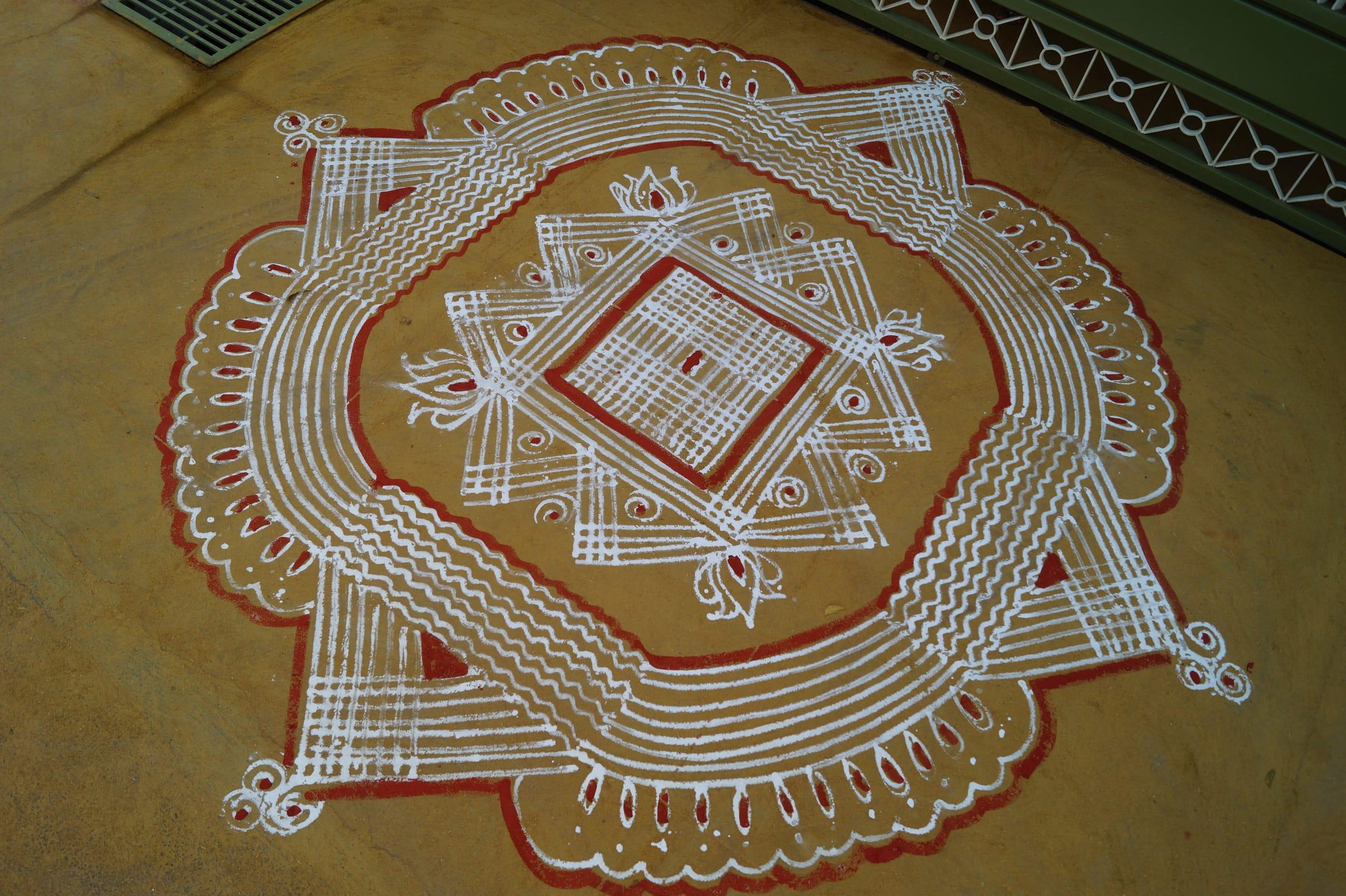

Early in the morning, before the sun is up, a new drawing appears on a doorstep in Tamil Nadu. By the end of the day it is gone. Feet have walked over it. The wind has blown it. Ants and birds have eaten it.2Source 2University of San Francisco, Thacher Gallery, “Feeding a Thousand Souls” exhibition, 6 Mar–7 Apr 2019Open the source Nobody is sad about this. It is meant to happen.
Dots, lines and loops
The drawing is called a kolam. Every day, millions of women in Tamil Nadu wake up before dawn to draw one at the door of their home.1Source 1Vijaya Nagarajan, Feeding a Thousand Souls (Oxford University Press, 2018), publisher’s pageOpen the source Some kolams are small and simple. Some are big and full of loops.
In Tamil, the word kolam means beauty. It also means form, play, disguise and design.2Source 2University of San Francisco, Thacher Gallery, “Feeding a Thousand Souls” exhibition, 6 Mar–7 Apr 2019Open the source That is a lot of meaning for one small word.
In the cool month of Margazhi, in December and January, many families draw bigger kolams than on other days.6Source 6Nature inFocus, “Kolam: the art of everyday sustainability” (undated)Open the source7Source 7The New Indian Express, “Kolam: art rooted in ritual”, 20 Dec 2025Open the source
Why rice flour?
Kolams are made with rice flour.1Source 1Vijaya Nagarajan, Feeding a Thousand Souls (Oxford University Press, 2018), publisher’s pageOpen the source The white flour shows up well on the ground. And rice flour is food. When the women draw with it, they feed the insects and small animals that live near them.3Source 3BBC Reel, video on the kolam, 3 Jul 2019Open the source They think of these tiny creatures as neighbours.3Source 3BBC Reel, video on the kolam, 3 Jul 2019Open the source
The writer Vijaya Nagarajan has studied kolams for many years. She calls the kolam “a ritual of generosity”.4Source 4Atlas Obscura, “Indian rice art kolam”, 7 May 2019Open the source A ritual is something people do again and again, in the same way. Generosity means giving to others, happily. So a kolam is a way of giving, every single day.
Who comes to eat?
Ants come. They find the flour and carry tiny bits of it home. Birds come too, and other bugs and insects.4Source 4Atlas Obscura, “Indian rice art kolam”, 7 May 2019Open the source
Think of it as breakfast, laid out at the door. The guests are very small, and there are a lot of them. That is why Nagarajan named her book about kolams Feeding a Thousand Souls.1Source 1Vijaya Nagarajan, Feeding a Thousand Souls (Oxford University Press, 2018), publisher’s pageOpen the source
Art that is meant to fade
Most art is made to last. A painting goes in a frame. A statue stands in a park for years. A kolam is not like that. It is gone in a few hours.2Source 2University of San Francisco, Thacher Gallery, “Feeding a Thousand Souls” exhibition, 6 Mar–7 Apr 2019Open the source
Then, the next morning, someone draws a new one. A kolam is a gift that is given again and again. It asks for nothing back.
Kolam today
Today, more and more people draw kolams with stone powder or paint.4Source 4Atlas Obscura, “Indian rice art kolam”, 7 May 2019Open the source One writer remembers her family moving from rice flour to limestone powder in the 1990s.5Source 5The New Indian Express, “Connecting the dots”, 2 Feb 2020Open the source Stone and paint last longer. But ants and birds cannot eat them.
Feeding tiny creatures is not the only reason people draw kolams. For many families, a kolam is also a prayer and a way to say welcome.6Source 6Nature inFocus, “Kolam: the art of everyday sustainability” (undated)Open the source But a kolam made with rice flour still shares a little food with the smallest guests.
At Friends of Animals, we love art that is kind. A kolam is both at once: a picture for people, and a meal for ants.